
Shopping Cart
There are no more items in your cart
When choosing a barrette, people look at the colour, the shape, the crystals. Almost never at the clasp. Yet the clasp decides whether the accessory lasts ten years or six months.
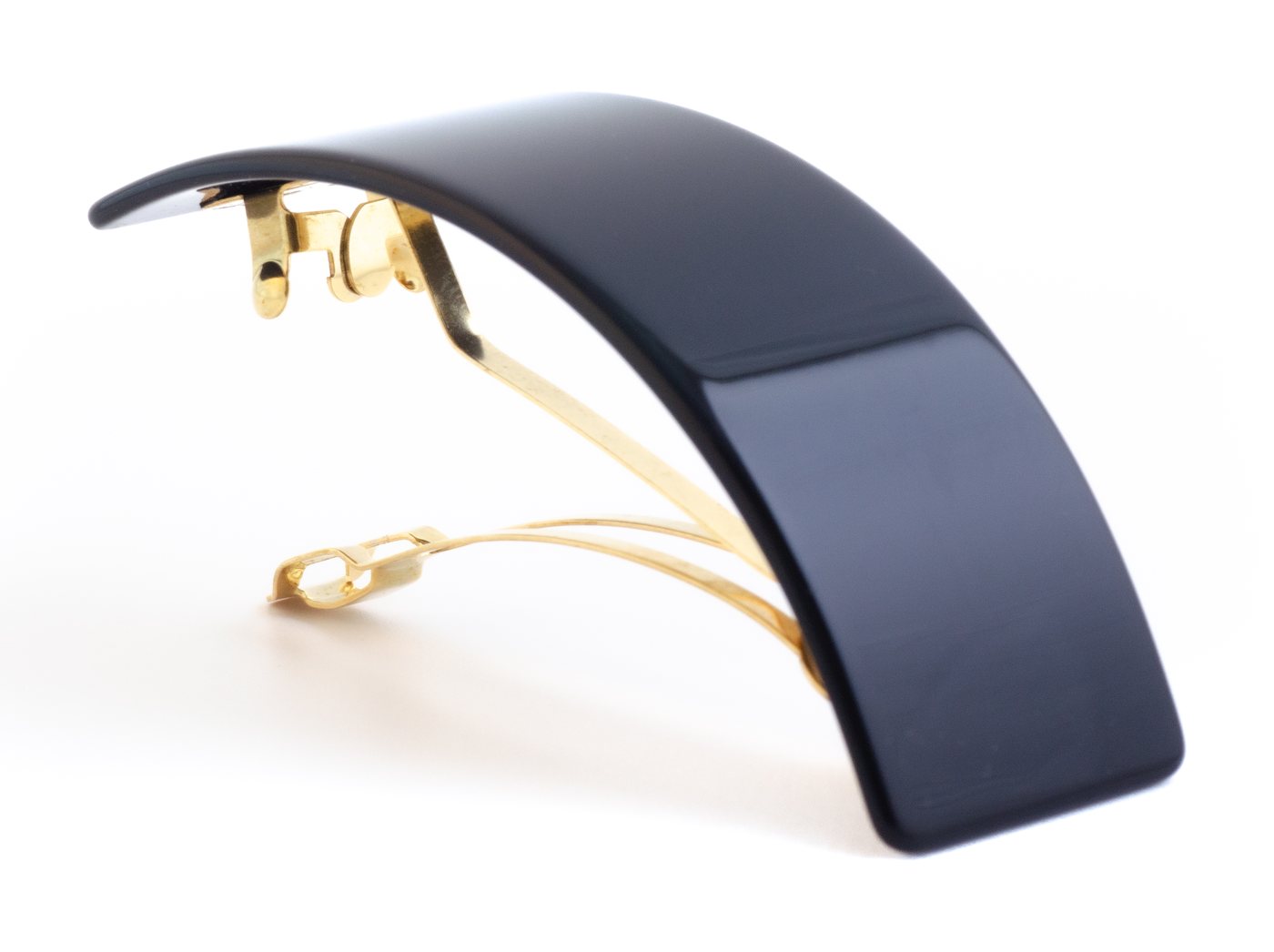
Quick summary
- The clasp, or matic, is the part of a barrette that decides its lifespan.
- The French matic was invented by Delsol in 1909 and is known worldwide as the French clip.
- The Delsol matic is a two-piece mounting: a spring blade and a hinged rod, no rivet.
- Five matic lengths, from 5 to 11 cm, cover every hair volume.
- Heat, damp and household glue are what ruin a barrette. A clasp can be replaced; glued acetate cannot.
The part nobody looks at
The clasp, or mounting, is the metal part fixed to the back of the barrette. It is called the matic, short for the French automatique, because it closes by itself in one movement. It carries the spring blade, the rod and the opening mechanism.
Fine acetate does not make up for a poor clasp: the clasp is what gives way first, and the barrette becomes unusable while the acetate itself is still perfect.
At MC Davidian this part has historically come from one French manufacturer, Delsol. Its story explains a great deal about the French barrette, and about what is changing today.
Delsol, inventor of the automatic barrette
If the system barrette is called the French clip worldwide, the reason is a workshop in Bagnolet. Charles and Léona Delsol founded a general engineering business there in 1909, working first in wrought ironwork.
The automatic barrette came out of that workshop, credited to Charles Delsol. The mounting was adopted everywhere under the name French clip, and it has barely changed since.
What followed is a familiar French industrial story. In the early 1970s the company left Paris for Chasseneuil-du-Poitou with some 300 employees, the only firm in the world mastering every technique of its trade. In 1978 it bought Paccaud and Guichon, taking control of the whole chain.
At its height the Poitou plant employed around 350 people and shipped to some forty countries, among them Germany, Spain, Portugal, the United States, Japan and China. Mountings made in a French village were being exported to the very countries that would later compete with them. Exports once accounted for 70 to 75% of turnover; by 2014, undercut by low-cost production, they were down to 22%, as the local press reported at the time.
Then international competition arrived, several patents expired, and the company changed hands. It joined the FDG group in 2003, merged with it in 2016, and turned its production towards mass retail.
For us, the story ended recently: the Delsol mountings as we knew them are no longer produced. We are working through our last stock.
How a system barrette works
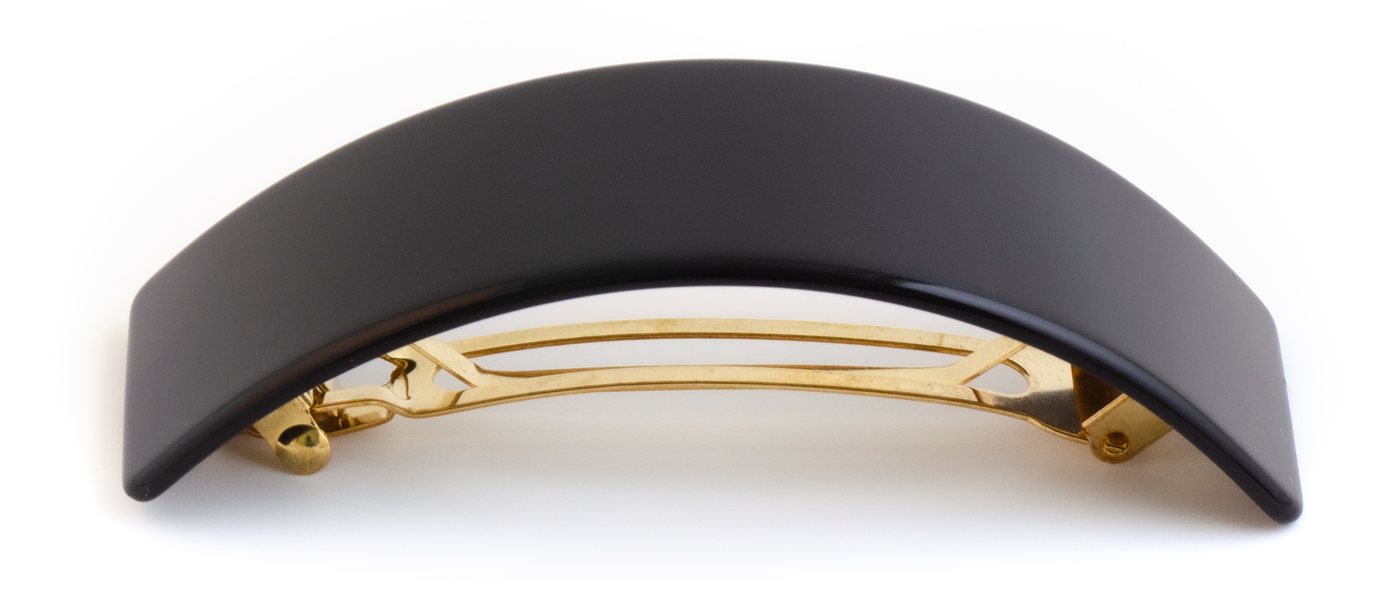
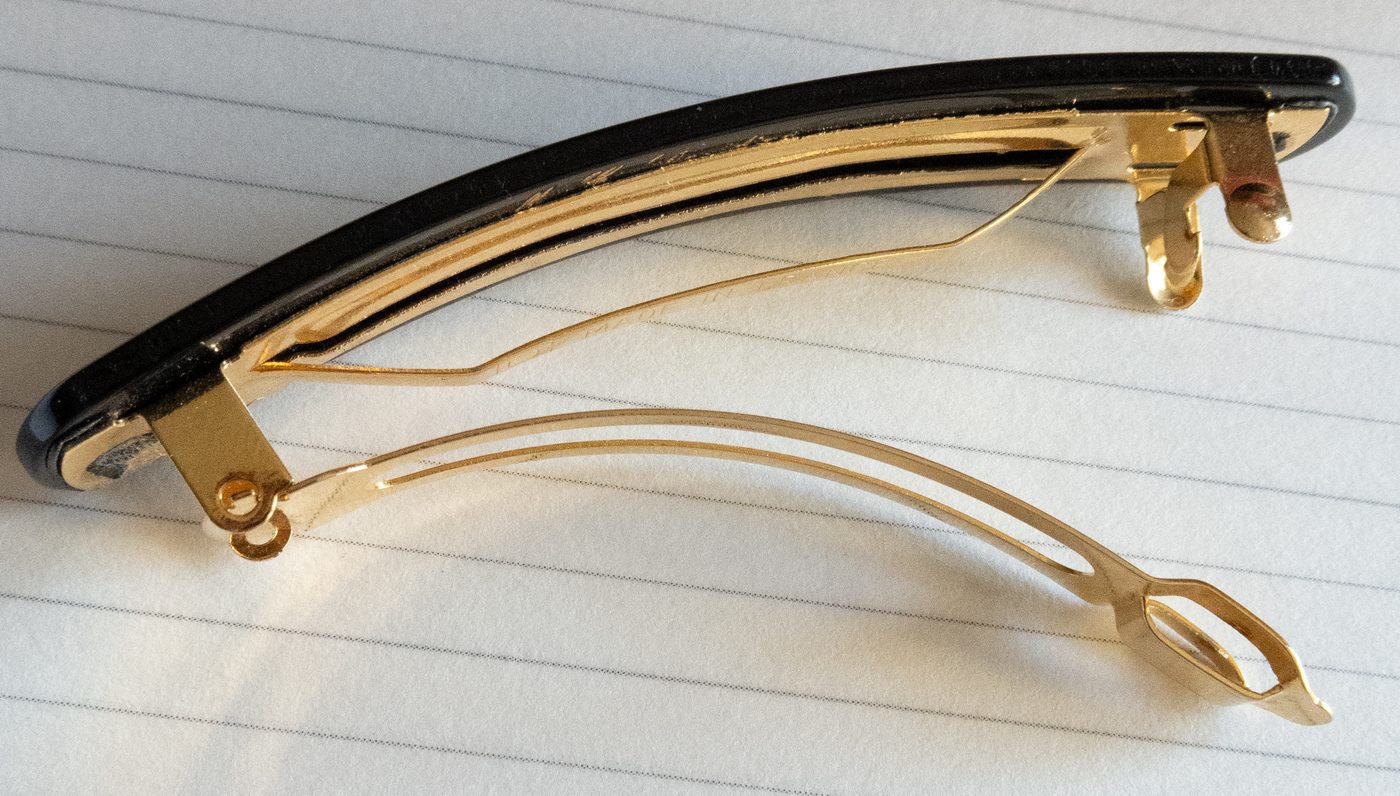
Two parts: a bowed metal blade, fixed to the matic at both ends, and a hinged rod that locks into a notch. Folding the rod down tensions the blade: the blade is the spring, and it is what grips the hair. It snaps, and that snap made the system's reputation, which we describe further in our article on the French hair barrette for ponytails.
Where mountings differ is in how the spring is obtained:
- Two-piece mounting: the blade is both frame and spring, formed from a single piece of metal. No rivet, so fewer failure points. This is the construction of the French matic, the one on our barrettes.
- Three-piece riveted mounting: the spring is a separate piece, fixed to the frame with a rivet. It adds an assembly, and a poorly executed rivet is where a mounting gives way. Well made, it holds; the difference is in the execution, not in the principle.
In use, two things matter. First the spring strength: too weak and the barrette slips on fine hair; too strong and it marks the hair and fatigues the acetate. Second the life of the fold, or of the rivet when there is one, which is where a barrette breaks, almost every time.
That is why a failing barrette is repaired at the clasp, not with glue. More on that below.
The five matic lengths
It is the length of the clasp, not of the barrette, that determines hold. An 8 cm matic sits on a barrette of roughly 9.5 cm: the difference is the acetate overhanging each end.
| Matic length | Size | Hair volume | Style |
|---|---|---|---|
| 5 to 6 cm | PM | Fine or light | Half-up, small side ponytail |
| 7 cm | MM | Fine to medium | Mid-height ponytail |
| 8 cm | GM | Medium to thick | Classic low ponytail, bun |
| 8 cm, ponytail version | TGM | Thick or abundant | Full ponytail: the matic leaves more room for the hair |
| 10 cm | 10 cm barrette | All types, especially thick | Side, back or mid-height ponytail |
| 11 cm | 11 cm barrette | Very dense or abundant | High-volume ponytail, large chignon |
When in doubt, size up. A slightly large barrette is comfortable; one that is too small pulls, slips and wears out fast.
The matic finish follows the acetate colour: gold-plated for warm tones, silver or nickel for cool tones. Full detail in our size guide.
After Delsol
When a century-old supplier stops, a maker has to find a successor. Our brief was the one we have applied since 1980: consistent spring tension, an assembly that holds, a clean finish.
It is slow work, because a mounting is judged in use, not from a sample.
Our new mountings come from South Korea. The country has built a genuine hair accessory industry, and the parts we receive meet our requirements for machining tolerance and spring consistency.
Depending on the model, they are made of two or three pieces of metal. We would rather say so plainly: a three-piece mounting is not a lesser one, provided the rivet is properly set, and each type is accepted only once it has been tested on our own barrettes. What we do not accept is a spring that slackens or an assembly that moves.
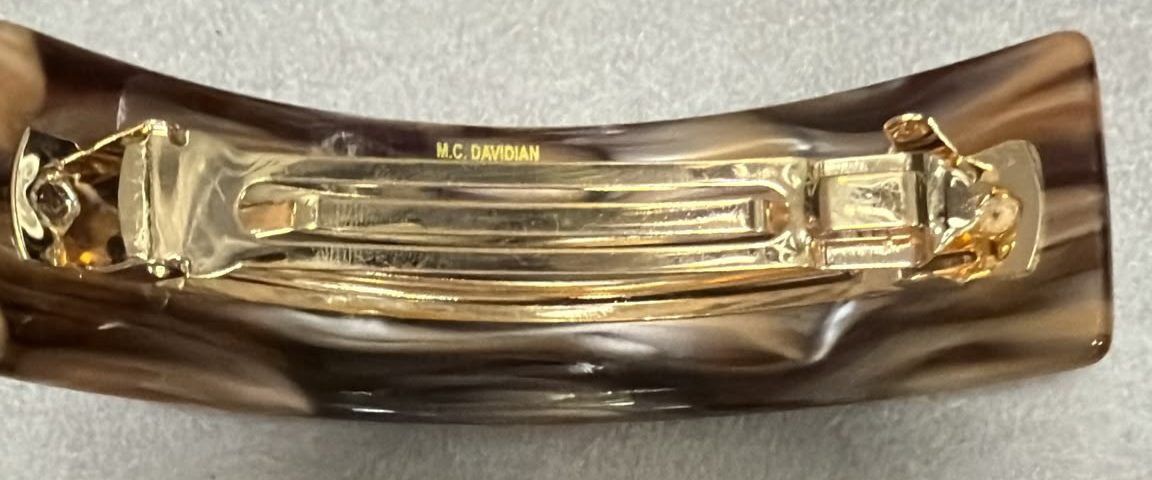
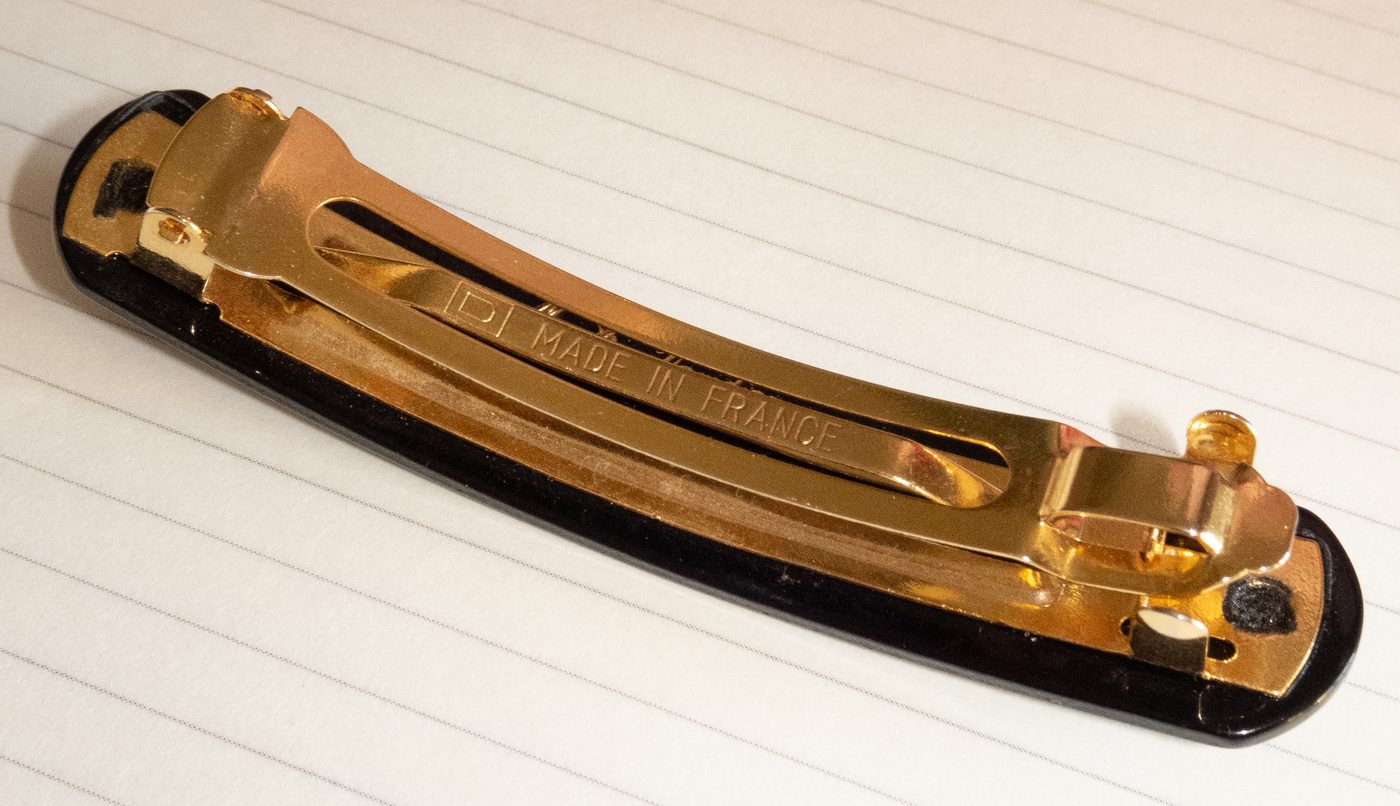
In practice the transition is gradual. Most of what we ship today still carries a Delsol mounting, stamped M.C. Davidian, Made in France. The Korean mountings arrive as stock runs out, model by model.
If this matters to you for a particular model, write to us: we will tell you which mounting it is fitted with today, with photographs.
Care and repair
A system barrette lasts years if you respect three things.
Heat and damp are the two enemies
Cellulose acetate deforms with heat, and the elastic in scrunchies stretches permanently. A hairdryer aimed at the accessory, a washing machine cycle, a car in summer sun: each is enough to damage an accessory beyond recovery.
Damp goes after the metal instead. A steamy bathroom, a beach bag left closed, sea water or chlorinated pool water will all mark a mounting in the end. Rinse with clean water and dry after the beach or the pool, and keep your accessories somewhere other than the edge of the basin.
Never glue it yourself
This is the costliest mistake. Common glues, cyanoacrylate above all, attack the acetate and leave a permanent white mark. A broken but clean barrette can be repaired; a glued one cannot.
The clasp is replaceable
In most cases a barrette that no longer holds has a mounting problem, not an acetate problem. That part is removed and changed at the atelier.
If one of our hair accessories breaks, write to us first: our repairs and after-sales service page explains how. We will tell you whether it can be repaired, and on what terms. For spring hair clips, which are a different mechanism, we have a dedicated tutorial.
The Clasp Is the Barrette
Every MC Davidian barrette is fitted with a French matic and handmade in France since 1980.